*** Don't feel like reading? No worries! Watch us discuss this bill on Youtube or our Substack, or listen to the discussion on our Podcast: BillTrack50 Beyond the Bill Number on Apple Podcasts, Spotify, YouTube or where ever you get your podcasts ***
In 2024, IssueVoter analyzed 131 significant pieces of federal legislation, providing balanced perspectives on bills that aimed to shape American policy. BillTrack50 is very pleased to partner with IssueVoter and we link to each of those analyses at the top of the BillTrack50 bill page. We can also track how many people read each bill on the BillTrack50 system, to gauge interest in the bills.
As a new year, and a new Congress, has just begun, let’s look back at 2024 and see how the IssueVoter bills fared. Did they have the impact that the sponsoring legislators hoped?
Of the 131 bills and resolutions (117 from the House and just 14 originating in the Senate), only six were enacted into law, while another three faced presidential vetoes, highlighting the challenging path from proposal to law in today's political climate and highly polarised Congress.
This Stakeholder page shows all 131 bills:
What Bills Passed?
The RELIEVE Act (HR815) emerged as potentially the most consequential and controversial enacted legislation. Supporters argued its $27.9 billion in Ukraine funding was crucial for defending democratic values and preventing Russian expansion. As Senator Warner emphasized, "This investment in Ukraine's sovereignty is an investment in American security." Critics countered that domestic needs should take priority, with Representative Gaetz arguing, "We're sending billions overseas while Americans struggle with inflation and crumbling infrastructure." The bill's $4.4 billion for Israel's defense systems sparked similar debate, with supporters citing Israel's security needs and critics questioning the scale of military aid. Read the IssueVoter analysis here.
The Reforming Intelligence and Securing America Act (HR7888) represented a significant overhaul of surveillance practices. Civil liberties advocates praised its restrictions on FBI queries of U.S. person information, with some calling it "a step toward protecting Americans' privacy rights." Law enforcement organizations warned the restrictions could hamper investigations, with one FBI official testifying that "additional procedural requirements could delay critical time-sensitive investigations." The compromise version ultimately required supervisor approval for most U.S. person queries while maintaining emergency exceptions. IssueVoter analysis here.
President Biden's vetoes highlighted stark partisan divisions over regulatory policy - they were all joint resolutions disapproving rules created by the Biden administration. The joint resolution challenging the National Labor Relations Board's joint employer standard drew intense debate. Business groups argued the NLRB's rule would disrupt franchise models and increase costs, with a Chamber of Commerce warning it "threatens the independence of small businesses." Labor advocates countered that the rule properly holds large corporations accountable for working conditions, with the NLRB arguing it “ensures that the entities effectively exercising control over workers’ critical terms of employment respect their bargaining obligations.”
The veto of the resolution disapproving SEC's Staff Accounting Bulletin No. 121 exposed fundamental disagreements about cryptocurrency regulation. Crypto advocates claimed the bulletin's custody requirements would stifle innovation, while SEC defenders argued they were essential for investor protection. Critics responded that the rules were "regulatory overreach through guidance rather than proper rulemaking."
The EV charger Buy America requirements waiver veto highlighted tensions between environmental goals and domestic manufacturing. Environmental groups supported the waiver as necessary for rapid charging infrastructure deployment, while manufacturing unions opposed it as undermining domestic production, arguing, "We can't sacrifice American jobs in the name of speed," Secretary Buttigieg countered that some flexibility is needed to meet climate goals.
Looking at bills that stalled in committee reveals additional partisan flashpoints. Proposed restrictions on social media platforms' content moderation divided those prioritizing free speech from those concerned about misinformation. Healthcare proposals split between expanding government programs and market-based solutions. Immigration reform efforts faced familiar obstacles between enforcement-first approaches and pathways to legal status.
What bills attracted the most attention on BillTrack50?
The read counts on BillTrack50 suggest public engagement often peaks around controversial social and economic issues rather than the more technical legislation. The most read of all the bills was the Antisemitism Awareness Act of 2023 (which I wrote about back in May) seeking to change the definition of antisemitism under the Civil Rights Act. Followed by the Violence Against Women by Illegal Aliens Act (blog post here) and the DISGRACED Former Protectees Act (post here). The RELIEVE Act came in at number 10 and was the only one in the top 10 to actually be enacted. Its high readership reflects intense public interest in foreign aid and military spending. Joint resolutions challenging executive actions drew substantial attention, particularly when touching hot-button issues like labor relations and cryptocurrency regulation.
The contrast between enacted and failed legislation reveals an important pattern: while controversial regulatory and social issues generated the most public interest, successful bills generally focused on essential government functions or enjoyed some bipartisan consensus on national security. As one congressional analyst observed, "The gap between what generates public passion and what can actually pass Congress has rarely been wider."
This disconnect speaks to larger questions about representation and governance in an era of polarization. While IssueVoter's analysis highlights the competing viewpoints on major legislation, it also shows how rarely these fundamental disagreements find resolution through the legislative process. The low enactment rate - just 5% of tracked bills becoming law - suggests that despite intense public engagement with legislative debates, finding workable compromises remains exceptionally challenging.
Some reform advocates argue this indicates a broken system, while others see it as evidence that the constitutional design is working as intended - preventing major changes without broad consensus. What's clear is that understanding these competing perspectives, as IssueVoter strives to provide, remains essential for informed civic engagement, regardless of one's political views.
What do you think? Have your say by signing up to IssueVoter and make your voice count!
About BillTrack50 – BillTrack50 offers free tools for citizens to easily research legislators and bills across all 50 states and Congress. BillTrack50 also offers professional tools to help organizations with ongoing legislative and regulatory tracking, as well as easy ways to share information both internally and with the public.
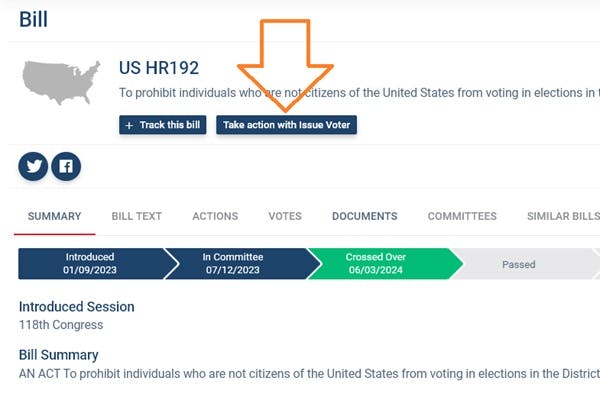
IssueVoter is a nonpartisan, nonprofit online platform dedicated to giving everyone a voice in our democracy. As part of their service, they summarize important bills passing through Congress and set out the opinions for and against the legislation, helping us to better understand the issues. BillTrack50 is delighted to partner with IssueVoter and we link to their analysis from relevant bills. Look for the IssueVoter link at the top of the page: