


On November 4, 2025, California voters approved Proposition 50, authorizing the state legislature to take over congressional redistricting for the remainder of the decade. It was an unusual move in a state long celebrated for its independent Citizens Redistricting Commission—a body created to shield the process from partisan influence. Yet by 2025, political winds had shifted, and the legislature, backed by Governor Gavin Newsom, sought to reclaim the map-drawing pen.
For context, California’s independent commission had been established through the Voters First Acts, Propositions 11 and 20, which removed the legislature from redistricting following the 2000s’ gerrymandering controversies. The commission, composed of citizens rather than lawmakers, drew the maps used in the 2012, 2014, 2016, 2018, 2020, and 2022 elections. Those maps were widely regarded as fairer and more transparent than the back-room deals that had preceded them.
But by mid-2025, state and national politics had begun to recast the debate. Several Republican-led states, notably Texas, were preparing mid-decade redraws of their own congressional districts, which many Democrats viewed as attempts to expand GOP representation in the U.S. House. In California, Democratic leaders framed Proposition 50 as a necessary countermeasure—a way to ensure the state’s influence in Congress wasn’t diluted by what they called partisan map-making elsewhere.
The Legislation
To make the proposal possible, the California Legislature introduced and passed a series of coordinated bills in August 2025. The central measure, Assembly Constitutional Amendment 8, sought to temporarily transfer redistricting authority from the commission back to the legislature. Companion bills, Senate Bill 280 and Assembly Bill 604, established the procedures for the change, called the special election, and laid out how the new maps would be implemented. Together, the package cleared both chambers with the two-thirds majority required for a constitutional amendment—57 votes to 20 in the Assembly and 30 to 8 in the Senate. The votes went almost entirely along party lines, with Jasmeet Bains the only dissenting Democrat in the Assembly. Bains is currently running for Congress in a competitive district. Governor Newsom swiftly signed the related legislation, setting the stage for a special statewide vote in early November.
The measure was assigned the ballot title Proposition 50, and the official voter guide framed the question in plain terms: a “yes” vote would allow the legislature to draw new congressional maps to be used in the 2026, 2028, and 2030 elections; a “no” vote would leave the independent commission’s maps in place until the next census. The proposal also acknowledged limited fiscal effects, such as one-time administrative costs for counties to update election systems and materials.
Campaign season quickly turned fiery. Proponents, led by the Democratic majority and allied organizations, argued that Prop 50 was a strategic and patriotic defense of California’s political voice on the national stage. Governor Newsom described it as “California standing up for fair representation when others won’t.” Supporters claimed that while the change was temporary, it was vital to preserve equitable influence in Congress during a period of aggressive redistricting elsewhere.
Opponents, primarily Republicans and good-governance advocates, decried the measure as a power grab that dismantled hard-won safeguards against partisan gerrymandering. Editorial boards and watchdog groups warned that Prop 50 would unravel the credibility of the state’s redistricting reforms and reignite the very cynicism that the independent commission had been designed to end. Critics cast the effort as self-serving—an attempt by Democrats to lock in their existing dominance under the guise of defending fairness.
The Vote
In the end, Prop 50 passed easily, with 63.9% voting Yes and 36.1% voting No. There were 8,280,930 votes cast, a turnout of 35.9%. While this is low compared to the 2024 presidential election where turnout was 59.97%, it is still notable that so many Californians turned out for an off year special election with just one question on the ballot.
The New Map
AB 604 defined the new congressional map which is now in force until the next census redistricting effort in 2030. Below you can see how the 2024 presidential election would have been different using the new map, with the excellent analysis courtesy of friends-of-BillTrack50 Ballotpedia:

Under Proposition 50, five Republican-held congressional districts shifted to become more Democratic, based on presidential election results from 2024. Kamala Harris (D) would have won three—District 1, District 3, and District 41—with margins above 10%. District 48 would lean Democratic, with a margin of 3%. District 22 would have shifted four percentage points toward Democrats; however, Donald Trump (R) would have won the district with a margin of 2%.
This illustrates the dangers inherent in redistricting in this way, which also apply in Republican controlled states such as Texas. To reliably win all five of the new districts the Democrats will need a swing in their favor when the districts are next contested. While that is looking likely based on the strong Democratic performance nationally on Tuesday, there's no guarantee that fickle voters will continue the trend. And by grabbing these extra districts, the Democratic margin in other districts would be weakened - Ballotpedia's analysis shows that five more districts would have resulted in smaller majorities for Democrats in 2024 if the new map had been used, with their majority cut in half in some.
As long as Democrats can at least maintain or improve their performance in future election cycles then they will pick up seats, but should the political wind change then they could possibly end up losing seats instead, or simply trading some seats for others with little or no net increase. This risk is just as real in Texas, where a strong Democratic showing could wipe out any Republican advantage from their redistricting.
It's also interesting to compare the changes in electoral outcomes with the vote distribution for the Prop 50 vote:
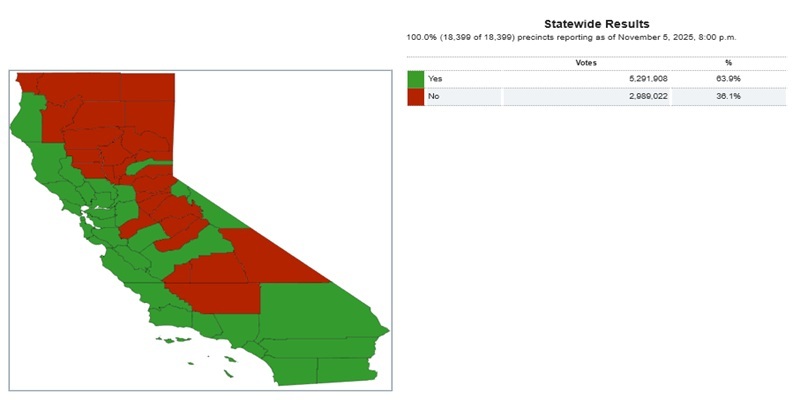
From https://electionresults.sos.ca.gov/returns/maps/ballot-measures/prop/50
The northern areas of the state, which are likely to flip from Republican to Democratic control, are, unsurprisingly, exactly those areas which voted against redistricting.
About BillTrack50 – BillTrack50 offers free tools for citizens to easily research legislators and bills across all 50 states and Congress. BillTrack50 also offers professional tools to help organizations with ongoing legislative and regulatory tracking, as well as easy ways to share information both internally and with the public.