


https://pixabay.com/photos/drone-technology-flight-recognition-2465315/
Choosing between foot patrols and drone surveillance for security isn’t just about tech and logistics, though. It’s also about what the rules allow. In the U.S., FAA regulations like Visual Line of Sight (VLOS) and Beyond Visual Line of Sight (BVLOS) are crucial to know about.
Why do you need to remember these rules when you plan patrols or drones? Ignoring them can lead to fines, shutdowns, or accidents.
Everyday Security Challenges
Imagine two common security scenarios. One is a large outdoor complex such as a distribution facility, solar array, refinery, sports complex, or university campus. This will have a significant perimeter, probably lots of dark spaces, and roofs that you can’t reach from the ground.
The other is a dense, multi-building setting, such as a corporate park, hospital, college campus, data facility, or office building. In this type of area, the line of sight is blocked by nearby buildings. Problems can occur in alleys, parking garages, or courtyards.
Foot patrols, whether local or multi-state security guard services, provide a human presence that deters many problems. People can also carry out tasks like door checks and de-escalating situations.
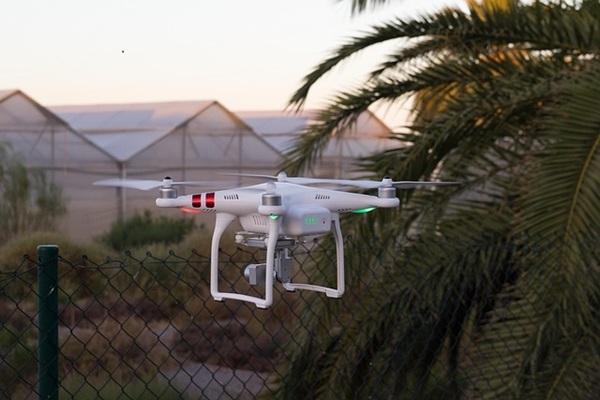
Drones are best when you need real-time situational awareness, as when an alarm goes off and an area has to be swept. Circumstances may also arise in which you need to clear a rooftop, look at suspicious activity at a rail spur at night, or find out what’s going on in a remote corner of a property. In this kind of scenario, a drone can provide fast information, whereas sending a patrol would be a lot slower.
Summary of Regulations
Let’s look at the main FAA rules, as these are what determine whether drones can realistically enhance or replace foot patrols.
VLOS
VLOS is the standard under FAA Part 107, the primary set of rules for commercial drone use. It requires you to keep the drone within your line of sight, with no tech aids like screens or binoculars. You have to be able always to see its position, altitude, and potential hazards.
This alignment ensures quick reactions to problems, but it limits the drone’s range to what you can see. It’s great for open sites but tricky in cluttered areas. For the complete text, check 14 CFR §107.31 and Subpart B.
BVLOS
BVLOS is more advanced. It means flying beyond what you can see directly, allowing drones to cover vast areas like long perimeters without constant monitoring. The catch is, you need a special FAA waiver or authorization involving safety proofs like detect-and-avoid tech or extra observers.
The FAA is developing a new rule called Part 108 to make BVLOS easier and more routine. This change could take effect as early as 2025, though industry watchers warn that delays due to testing and feedback are likely. This could revolutionize security for large sites, but until then, you have to deal with what’s on the books now.
Remote ID
Remote ID is another must. Most drones have to broadcast their identification and location so authorities can track them for safety and accountability. You can skip this in designated FAA-recognized Identification Areas (FRIAs), but VLOS rules still apply unless you have a waiver. It’s crucial for security because it builds trust and avoids “mystery drone” complaints.
Public Agencies and Local Regs
Public agencies like police and fire departments have more flexibility. They can operate under a Certificate of Authorization (COA) for special BVLOS flights, such as Tactical BVLOS in emergencies. This leeway allows short-range flights with buffers around obstacles, but is strictly limited and not suited for standard commercial operations. If your security is connected to public areas, this may allow you to exploit this loophole.
The FAA rules the airspace, but states and cities have their own privacy and data regulations that you need to be familiar with. The best policy is to be up front. Use signage, minimize data gathering. Just keep in mind that you need to comply with local as well as federal regs.
Drones’ Edge Over Patrols
- Drones beat patrols for speed.
- They zip over perimeters, roofs, and blind spots.
- They boost awareness with thermal/zoom cams, providing specific information about what is happening and where.
- They cut risks by scouting dangerous spots first.
- Drone surveillance provides video documentation of incidents.
Advantages of Patrols
- Guards offer a visible deterrence that a drone can’t match.
- They offer on-the-spot judgments and decisions. They can assess a situation and de-escalate when possible.
Drones can falter in bad weather or noisy spots.
Use Human Patrols and Drones to Your Best Advantage
Neither humans nor drones are objectively better. Ideally, use both to your best advantage. Patrols provide a human touch. Drones add speed and eyes. Find the right balance for your needs. Use VLOS drones to guide patrols. Pursue BVLOS if justified. A good principle is to scout in the air and respond with boots on the ground.
Jordan McDowell
Writer & Content Strategist
Philadelphia, PA