


Introduction
In this post we look at a fairly complicated bill, HB1074 from Indiana. This bill would allow for terminally ill patients to request medication to end their own life. The intended use of course being to help those in severe pain, with no chance of recovery take a quicker and less painful way out.
The bill was introduced in 01/04/2021 and has been in committee since then. This is still the case as of 08/13/2021.
The bill only has one sponsor; Matt Pierce, a Democrat.
While the topic of this bill sounds quite simple, it is anything but, the bill is quite long and complicated, with plenty of requirements from both the patient and the doctors. This post will break the bill down into easy to understand sections, if you would prefer to simply read over the bill yourself then you can do so here on our website, do be warned, it is quite long!
Overview
As mentioned briefly before, this bill focuses on the procedure required for one to receive a end of life medication, which is essentially a medication that will kill an individual. Only people that fulfill a large number of requirements are able to get the medication, one of those requirements being that the patient must be terminally ill.
As this bill is quite complicated, this post will be split into the following sections; Requirements of the Patient, Requirements of the Doctors, and Life Insurance/Other Notes.
There is also a list of other similar bills from the current session. You can take a look at this list here. If you would prefer to view it on our BillTrack50 Mobile App, then you can do that also using the code: EUTRXR. The Death With Dignity National Center, also has excellent resources on bills on this topic; you can view the interactive map they have made here.
Requirements of the Patient
For a patient to be able to receive medication under this bill, they must meet numerous requirements.
First, the patient must be mentally sound and is required to have a consultation to ensure that they are not suffering from any mental condition/disorder or anything similar, that would prevent them from making an informed decision. Essentially, they want to make sure the patient is in a sound state of mind and not being coerced before they make the decision
Second, the patient must be 18 years or older.
Third, the patient must be a resident of Indiana. Hence, people from other states would NOT be eligible, only residents of Indiana would be eligible.
Fourth, the patient must have been diagnosed with a terminal illness, that must also be confirmed by a consulting provider, who is stated by the bill as someone who is qualified to make an informed diagnosis of the illness.
Fifth, the patient must make an oral request of their desire to take the medication, after a 15 day waiting period they must make a second request. The exception to this rule is if it has been diagnosed that they will die before that 15 day period, they can make the second oral statement earlier. This is essentially in place to give the patient time to think it over, to ensure that they do not make a rash decision.
Sixth, the attending provider (who is the individual who is primarily responsible for the care/treatment of the patient’s illness) must give the patient a chance to rescind their above statement before the 15 days pass. The patient is also able to rescind the statement at any time.
Seventh, the patient must provide documents that confirm they are from Indiana, this can be any of the following; Licenses/ID, Voter Registration, Ownership/Leasing of Property, or State Tax Returns.
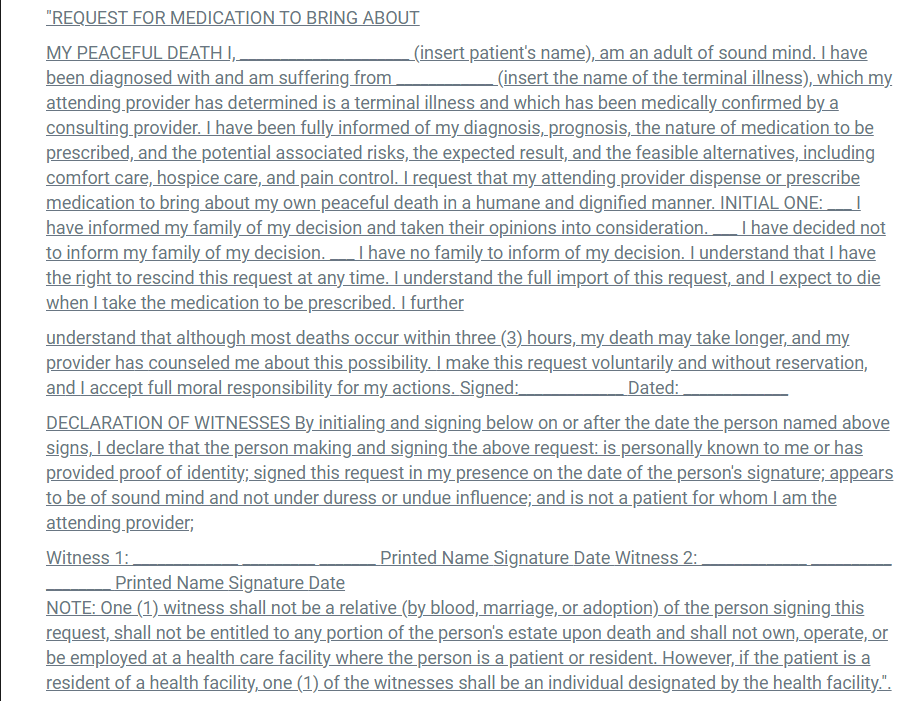
Eight, the patient must in addition to the above mentioned oral requests, make a written request on a government form. The form calls for the patient to sign. In addition to this, the signing must be watched by a minimum of two people, who can attest to the best of their knowledge that the patient is capable and not being coerced. One of the two witnesses must NOT be any of the following; related by blood, marriage or adoption, an heir, part of the health facility, or the attending provider. This is presumably to prevent anyone who might benefit from their death from being a witness (more on this later!).
Note: If the patient is a resident of the health facility, then one of the above individuals must be from the health facility.
Below is an image of what the form looks like.
As a short recap a great deal is required of the patient who wants to end their own life. If even one of these is not fulfilled then medication won’t be provided. However, there is more yet that must be done on the doctors part before the patient can get the medication to end their life.
Requirements of the Doctors
In addition to the large amount of requirements for the patient. The medical providers involved also have a number of requirements that must be meet before medication can be given.
First, the attending provider, who is defined in the bill as the individual who is primarily responsible for the care/treatment of the patient’s illness, must make an assessment/do all of the following;
- Confirm that the patient is terminally ill
- Confirm that the patient is mentally capable of making the choice
- Verify that the patient is not being coerced
- Refer the patient to a consulting provider
The attending provider must also check the following/inform the patient of all the following info
- Get the patients proof of residence
- Inform the patient of their diagnosis/prognosis
- Inform the patient of any risks from the medication
- Inform the patient of the intended effect of the medication (death)
- Offer the patient alternatives to the medication
- Recommend to the patient that they should inform their next of kin (they cannot be forced to, and refusing to do so does not prevent the patient from getting the medication)
They must also tell the patient about the things to do/not do with the medication;
- Inform the patient of the importance to have someone else present when the patient takes the medication
- Inform the patient not to take the medication in public
- Inform the patient that they can rescind the request for the medication at any time
- Verify that the patient is making an informed decision
- Ensure that all the requirements for the medication have been met and inform the patient that the medication can be given by a pharmacy, if requested.
If the Attending provider believes they are not fit to make the choice, then they must send the patient to a counselor (more on this later).
Second, the consulting provider must do the following;
- Medically confirm the terminal illness of the patient
- Verify the patients capability to make the choice
- Verify that the patient is not being coerced
The consulting provider must also do the following;
- Check the patient’s medical records and confirm in writing that they (the consulting provider) agree with the attending providers terminal illness diagnosis
- Verify the patient is capable of making a voluntary choice to take the medication
If the consulting provider believes they are not fit to make the choice, then they must send the patient to a counselor (more on this later).
Third, If a patient is sent to counseling, then medication can’t be given until the counselor determines the patient is capable of making a decision.
Fourth, if the counselor determines that the patient is fit to make the choice, then before the medication can be given, the attending provider must once again inform the patient of all of the following;
- The medical diagnosis/prognosis of the patient
- The risks from the medication
- The result of taking the medication
- Any alternatives to taking the medication
- Must confirm the decision to take the medication is informed
Fifth, the attending provider must document all of the following in the patient’s medical record;
- All oral/written requests for medication
- The attending providers diagnosis/prognosis
- Determination that the patient is capable of making the choice to take the medication and not being coerced
- There must also be documentation that shows that there was an offer to rescind the patient’s request for the medication
- There must be a medically confirm certificate of imminent death of the patient
- The attending provider must also include a statement that all requirements of this bill have been meet
They must also document the consulting providers determination of the following;
- That the patient is capable and not being coerced
- They must also detail any consoling that happened and the results of the consoling
As you can see from all of this info so far, there are a great deal of steps that a terminally ill patient must go through before they can get any end of life medication. Hence, they will not be just giving it out to anyone. There are strict requirements that must be met and multiple people must sign off on it. The bill makes the process fairly safe and does its upmost to prevent any fraud or coercion.
Life Insurance/Other Notes
Once all of the above steps have been completed medication to end one’s life can be provided to the patient. But, what happens after that?
The main important thing to note is in relation to life insurance policies. The bill lays out that policies cannot be conditioned upon or affected by a person making the request/taking the end of life medication. Additionally, life insurance policies can still be claimed even if the death is medically induced under this bill (suicide clauses do NOT apply). The amount of time that has passed between the death and claiming is also irrelevant.
In short, life insurance policies are still valid even if someone takes the medication.
The other main thing to note, is that those who give the medication are also immune from criminal liability from related effects. Additionally, health workers cannot be forced to carry out the medication, but they are in that case required to hand it off to someone who will.
Interview with the Death With Dignity National Center
Over the course of this blog post we have covered the facts of the bill. In this section we will take a look at the views of the Death With Dignity National Center on the issue of end of life options.
PLEASE NOTE: The following views are those of the Death With Dignity National Center, and may not reflect the views of this author, or the views of BillTrack50.
The interview was in a question and answer format. The questions and answers are as follows;
Q1. Why is end of life medication (or similar things) important?