*** Don't feel like reading? No worries! Watch us discuss this bill on Youtube or our Substack, or listen to the discussion on our Podcast: BillTrack50 Beyond the Bill Number on Apple Podcasts, Spotify, YouTube or where ever you get your podcasts ***
What Repealing Tailpipe Rules Would Mean
The Fuel Emissions Freedom Act would wipe away the core federal and state rules that limit what comes out of vehicle tailpipes and how efficient new cars must be. Supporters cast it as overdue deregulation that lowers costs and restores consumer choice. Opponents call it a sweeping rollback that would harm public health, weaken U.S. competitiveness, and override states that want stronger protections. Here’s a concise look at what the bill does and what’s at stake.
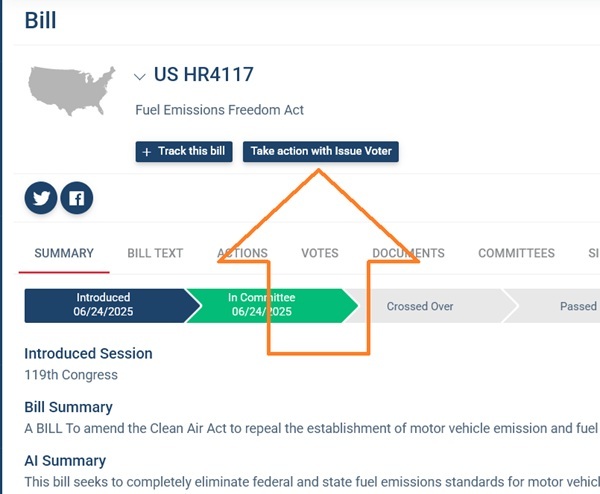
Read the full IssueVoter analysis here.
A Short History of How We Got Here
California established the nation’s first tailpipe limits on pollutants in 1966, ahead of federal law. Since 1970, the Clean Air Act has required EPA to set national limits on vehicle pollution. California received special authority to adopt stricter standards because of its severe smog; other states could choose to follow California’s rules. That two-track system, paired with federal fuel-economy (CAFE) standards, pushed technologies like catalytic converters, cleaner fuels, and more efficient engines, cutting smog-forming pollutants by over 90% since the 1970s even as Americans drove more. Automakers had to meet at least the federal requirements, and in practice often aligned with California’s higher bar, effectively making California’s policies a nationwide norm in the auto market. The Fuel Emissions Freedom Act would upend this model by eliminating EPA’s tailpipe program, canceling California’s waiver, preempting states from enforcing stricter rules, and repealing CAFE.
What The Bill Proposes
The bill repeals Section 202 of the Clean Air Act (tailpipe standards) and related provisions, voids California’s waiver and any state standards tied to it, and abolishes federal fuel-economy requirements. If enacted, all existing limits on pollutants from cars and trucks – whether set by EPA, California’s Air Resources Board, or other states – would be nullified virtually overnight. No public agency, federal or state, could require automakers to curb tailpipe emissions or improve miles-per-gallon beyond what the market demands.
This radical deregulation is justified, in the bill’s text, by a series of congressional “findings” which argue that overlapping rules create uncertainty, raise costs, and stifle innovation. The sponsors, led by Rep. Roger Williams, frame the bill as restoring economic freedom and allowing the market—not regulators—to decide which vehicles succeed.
Economic Impacts: Costs Today, Competitiveness Tomorrow
Backers say automakers and suppliers spend heavily to comply with changing federal and California-led standards and pass those costs to consumers. A single national policy with no mandates, they argue, would simplify supply chains, reduce compliance spending, and lower sticker prices. Greater “regulatory certainty” could also help long-range planning.
Critics counter that clear standards have historically driven innovation and long-run savings. Cleaner engines and rising fuel economy reduced fuel and maintenance costs for drivers over the life of a vehicle, even when upfront prices rose. If mandates disappear, manufacturers may scale back efficiency and emissions controls that are costly to install but pay consumers back at the pump. Strategically, a deregulatory U.S. could fall behind Europe and China, where tight standards and zero-emission targets are accelerating investment. That risks locking domestic production into older technology, shrinking advanced supply chains, and eroding export competitiveness. Any short-term relief for manufacturers must be weighed against the long-term costs of losing the global race for cleaner vehicles.
Health and Air Quality
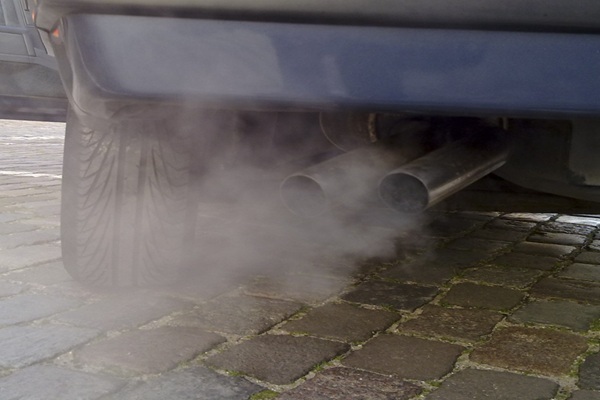
Transportation is a dominant source of urban air pollution. Tailpipe standards limit carbon monoxide, nitrogen oxides, particulates, and other toxins that contribute to asthma, heart and lung disease, and premature deaths. Public health groups and the Environmental Defense Fund warn that removing federal and state authority would raise exposure to these pollutants, especially in communities near highways and freight corridors. EPA and health advocates have long attributed significant gains in life expectancy and reductions in missed school and work days to cleaner vehicles. EPA estimated that its most recent light-duty emissions standards would save up to 2,500 premature deaths per year in 2055, while a recent American Lung Association study estimated that a 100% zero-emission vehicle network (powered by clean electricity) would prevent over 89,000 premature deaths, 2 million asthma attacks, and 10 million lost workdays by 2050. Vickie Patton, general counsel of the Environmental Defense Fund, called the prospect of EPA walking away from its responsibility “one of the most damaging actions, really, ever taken in the history of the EPA,” noting that the agency would be “just walk[ing] away from protecting the American people from some of the most dangerous pollution in our lives”
Without enforceable limits, opponents expect higher emissions as some models revert to cheaper, dirtier configurations, with the costs externalized onto hospitals, families, and local economies.
States’ Rights: Federalism Turned on its Head
For decades, California’s waiver has been a hallmark of cooperative federalism: states with worse air could go further, and others could opt in. The Act would federally prohibit any state from adopting or enforcing stricter tailpipe standards—while also ending federal standards. Proponents argue this avoids a patchwork and reduces compliance burdens. Opponents see it as Washington using preemption to stop states from protecting their residents, even when the federal government chooses not to regulate. That inversion—national power to mandate no standards anywhere—will be read by many state officials as an intrusion on traditional police powers to safeguard health and welfare.
Such preemption of state powers is striking. Traditionally, conservative policymakers champion states’ rights and local control over one-size-fits-all federal mandates. Yet the Fuel Emissions Freedom Act takes the opposite approach: it would impose a singular federal deregulatory vision on all 50 states, even those that want to maintain stronger pollution standards.
Legal scholars note that Congress does have the constitutional power to preempt state laws in favor of a national policy, but doing so here while simultaneously abdicating any federal regulation is, in the words of one analyst, comically misaligned with our federal system and basic principles of government.
Climate and the Global Context
Although the bill focuses on pollutants with direct health effects, removing standards would also slow or reverse progress on transportation greenhouse gases. With major trading partners tightening their rules and phasing in zero-emission sales targets, a U.S. retreat undermines domestic alignment with global markets. Proponents say market demand for efficient or electric models will persist without mandates. Critics respond that policy support is a primary driver of the pace and scale of adoption; without it, the transition slows, supply chains shrink, and U.S. firms cede leadership.
It could also have a knock-on effect internationally: U.S. retreat from vehicle emissions policy might embolden other countries to slow their own climate actions or could undermine negotiations by indicating a lack of U.S. leadership. Climate scientists warn that the world needs all major economies to strengthen, not weaken, emissions standards to avoid the worst impacts of global warming.
Will the Bill Pass?
As of now, H.R. 4117 has only been introduced and referred to the House Energy and Commerce Committee, with just three cosponsors and no movement beyond that point. It has not been marked up, scheduled for debate, or gained any visible bipartisan support. Given its sweeping rollback of both federal and state emissions authority—including revoking California's historic waiver and dismantling CAFE standards—it is highly unlikely to advance.
Even though the sponsors of the Fuel Emissions Freedom Act know it has little chance of passage, advancing the bill serves several strategic purposes. It signals to their constituents and allies that they are fighting against environmental regulation and aligning with broader themes of deregulation, energy independence, and consumer freedom. The proposal also stakes out an ideological position within ongoing debates over climate policy, allowing its authors to frame themselves as defenders of free markets against what they portray as government overreach. Finally, introducing such a sweeping measure can shift the political conversation—setting markers for future negotiations, energizing supporters in industry and conservative advocacy circles, and demonstrating loyalty to a deregulatory agenda even if the bill itself never becomes law.
In a nutshell: it burnishes the sponsors anti-environmental credentials, makes them champions of deregulation and paves the way, over time, for less extreme but still radical legislation that may pass.
About BillTrack50 – BillTrack50 offers free tools for citizens to easily research legislators and bills across all 50 states and Congress. BillTrack50 also offers professional tools to help organizations with ongoing legislative and regulatory tracking, as well as easy ways to share information both internally and with the public.
IssueVoter is a nonpartisan, nonprofit online platform dedicated to giving everyone a voice in our democracy. As part of their service, they summarize important bills passing through Congress and set out the opinions for and against the legislation, helping us to better understand the issues. BillTrack50 is delighted to partner with IssueVoter and we link to their analysis from relevant bills. Look for the IssueVoter link at the top of the page: