*** Don't feel like reading? No worries! Watch us discuss this bill on Youtube or our Substack, or listen to the discussion on our Podcast: BillTrack50 Beyond the Bill Number on Apple Podcasts, Spotify, YouTube or where ever you get your podcasts ***
A Legislative Response to Tragedy
In February 2024, the murder of 22-year-old nursing student Laken Riley on the University of Georgia campus shocked the nation and intensified the ongoing debate about immigration policy in the United States. The case garnered national attention when it was revealed that the perpetrator, Jose Ibarra, had entered the United States illegally in 2022. In November 2024, Ibarra was found guilty of all charges and sentenced to life in prison without parole.
The emotional impact of Riley's death was powerfully captured by her sister Lauren Phillips's testimony: "I cannot walk around my own college campus because I'm terrified of people like Jose Ibarra." This personal tragedy has become emblematic of larger policy debates about immigration enforcement, public safety, and the balance between humanitarian concerns and security measures.
An Early, Bipartisan Win for the New Congress
The tragic death became a catalyst for new legislation - the Laken Riley Act. As Senator Katie Britt (R-Ala.) stated, "This bipartisan, bicameral legislation will save lives, and it will help prevent another American family from feeling the pain Laken Riley's loved ones feel every day." The Act passed with notable bipartisan support, securing votes from both Republicans and some Democrats, including Senators John Fetterman and Ruben Gallego. It was signed into law by President Trump on January 29.
The Laken Riley Act introduces significant changes to immigration enforcement. At its core, the legislation requires U.S. Immigration and Customs Enforcement (ICE) to detain individuals who enter the country illegally and are charged with theft-related offenses. The act also empowers state attorneys general to sue federal officials who they believe are not properly enforcing immigration laws, particularly when their state experiences financial harm.
Read the IssueVoter analysis here.
Unintended Consequences
However, critics argue that the legislation may have unintended consequences. As noted in The New York Times, the bill's scope extends beyond its stated aims. Law professor Ilya Somin points out that "the Laken Riley Act could mandate the indefinite detention of a juvenile child of asylum-seekers arrested for swiping a candy bar, even if he or she didn't do it." The legislation applies not only to undocumented immigrants but also to authorized residents, including DACA recipients and those with temporary protected status.
In addition, ICE has warned that the provisions in the act could require the detention of 60,000 people, forcing them to release migrants already detailed to make enough room. Britt's office has pledged to make sure sufficient funds are provided to properly enforce the new law.
The Act emerges amid a broader national debate about immigration policy. In Florida, for instance, recent legislation would introduce strict measures including mandatory death penalties for undocumented immigrants convicted of capital offenses and the elimination of in-state tuition for DACA recipients. These developments reflect the increasing polarization of immigration policy at both state and federal levels, as I explored in this blog post. And even more extreme, Mississippi and Missouri have both introduced legislation to create a bounty hunting service to track down undocumented migrants and to make being undocumented in the states a crime punishable by life imprisonment without parole.
While supporters argue that the Act fills crucial gaps in immigration enforcement, critics contend that it may overcorrect, potentially violating civil rights and due process. The legislation's passage reflects the complex challenge of crafting immigration policy that effectively addresses public safety concerns while maintaining fundamental principles of justice and human rights.
As the United States continues to grapple with immigration reform, the Laken Riley Act serves as a testament to how individual tragedies can shape national policy, for better or worse. The ongoing challenge lies in finding a balance between preventing similar tragedies and ensuring that new laws don't create unintended victims of their own.
About BillTrack50 – BillTrack50 offers free tools for citizens to easily research legislators and bills across all 50 states and Congress. BillTrack50 also offers professional tools to help organizations with ongoing legislative and regulatory tracking, as well as easy ways to share information both internally and with the public.
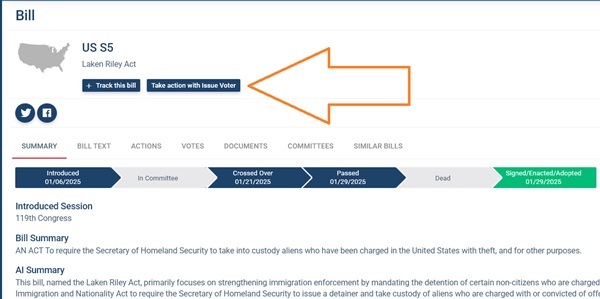
IssueVoter is a nonpartisan, nonprofit online platform dedicated to giving everyone a voice in our democracy. As part of their service, they summarize important bills passing through Congress and set out the opinions for and against the legislation, helping us to better understand the issues. BillTrack50 is delighted to partner with IssueVoter and we link to their analysis from relevant bills. Look for the IssueVoter link at the top of the page: