


Do you need to follow state regulations, but you're bamboozled by the process? Don't worry! Here's a quick primer on how it all works.
Once a bill becomes a law, regulations—or rules—are created by administrative agencies to describe and govern how the law will be implemented. Regulations have the same authority as laws and are reviewed by the governing agency to determine whether changes are needed, e.g. do codes need to be updated? Are there more efficient ways of implementing a law?
The process through which a regulation is finalized is similar across most states:
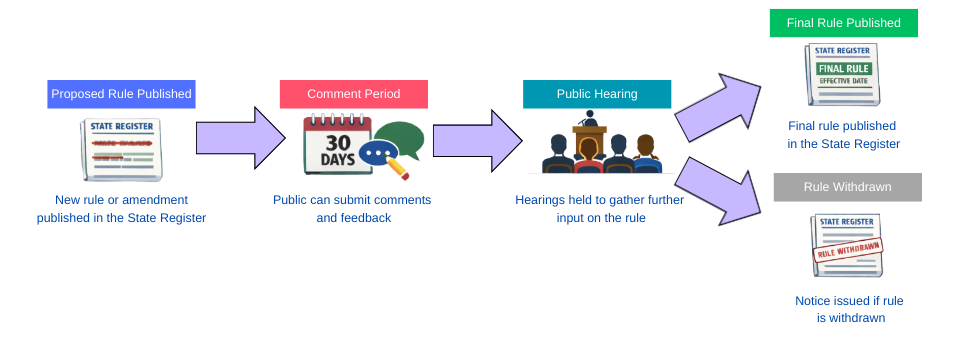
In general, once it is determined a new rule needs to be created or a current rule needs to be amended, the proposed rule or amendment is published in the state register. If there is an amendment to the current rule, the parts of the rule being amended will be struck and replaced with the new language.
Publishing the notice in the state register signals stakeholders and the public that there is an opportunity to provide comments about the proposed rule or amendment. This period is called the comment period, and is oftentimes open for 30 days. Each state agency accepting comments must review the comments and subsequently may adjust the rule or amendment based on public comments. States may also hold a hearing on the proposed rules or amendments. The date, time, and location of the hearing also should be included in the state register notice. After the hearing, the public is no longer able to submit comments. Rules or amendments, however, may continue to be adjusted by the agency.
A final notice of the new rule is published in the state register along with a date on which the rule will take effect.
Rules being withdrawn are also published in the state register notifying stakeholders and the public that the rule is being withdrawn.
Michigan Example: Electronic Return of Absent Voter Ballots by Eligible Voters
The State of Michigan provides a great example of the multiple notices published in the Michigan Register during the public engagement period to adopt a new rule. The rulemaking process began after a new law, Michigan Compiled Laws 168.759a, was passed to provide a secure method for eligible voters to electronically return their voter ballots.
Prior to the first notice appearing in the register, a department submits a Request for Rulemaking (RFR) to the Michigan Office of Administrative Hearings and Rules (MOAHR). MOAHR reviews and approves the RFR and notifies the Joint Committee on Administrative Rules (JCAR). Rules are drafted by the agency and submitted by the agency’s Regulatory Affairs Officer (RAO) to MOAHR to review for legal authority. MOAHR approves the draft rules and notifies JCAR. MOAHR sends the draft to the Legislative Service Bureau (LSB) for informal editing to comply with format and style requirements. The agency implements LSB’s suggested edits to the proposed rule and submits the revised proposed rule to MOAHR. (See the Rulemaking Process Summary for the full rulemaking process.) It is at this stage in the rulemaking process that notices will appear in the register.
There are 12 notices in this example:
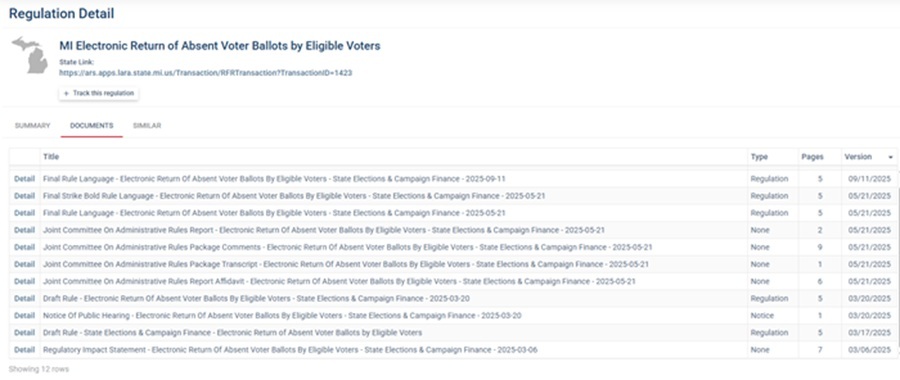
- Regulatory Impact Statement and Cost-Benefit Analysis (RIS) (March 6, 2025). The RIS explains that “the Secretary of State shall promulgate rules that establish policies and procedures for the electronic return of voted ballots by eligible members.” Essentially, Congress, through MCL 168.759a, established that rules must be created to allow for electronic voting. The RIS also:
- questions whether the proposed rule parallels federal rules or standards,
- compares the proposed rule to other states,
- identifies other Michigan laws that would conflict with the proposed rules,
- explains how the proposed rule was coordinated,
- details the proposed rule’s purpose and objectives, the fiscal impact on the agency, and any impacts on rural areas, the environment, and small businesses,
- provides a cost-benefit analysis of the proposed rule, and
- notes if there are alternatives to the regulation.
- Draft Rule (March 17, 2025). This document is the proposed rule for the new law.
- Notice of Public Hearing (March 20, 2025). The notice announces that the public hearing on the proposed rule will take place on Monday, May 12, 2025, at 9:00 am, when the public can share their comments. A physical mailing address and email address are also included for those wishing to provide written comments about the proposed rule by the given deadline.
- Draft Rule (March 20, 2025). The document is an updated version of the proposed rule for the new law.
- Joint Committee on Administrative Rules Report Affidavit (May 21, 2025). Per the Michigan rulemaking process, this document provides evidence that the notice of public hearing was published in a newspaper on Friday, April 11, 2025.
- Joint Committee on Administrative Rules Package Transcript (May 21, 2025). This notice typically provides a transcript of the comments made during the public hearing. No transcript is available as no public comments were provided.
Joint Committee on Administrative Rules Package Comments (May 21, 2025). This notice provides the written comments submitted by the public in response to the proposed rules.
Conclusion
The rulemaking process transforms legislative intent into practical, enforceable regulations through a structured and transparent series of steps. As demonstrated by Michigan’s process, regulations move from initial drafting to final approval through multiple steps involving review, public notice, and oversight. The example of the electronic return of absent voter ballots highlights how state agencies follow the rulemaking process in the Michigan Register, providing stakeholders and the public with opportunities to understand and participate in regulatory development. By publishing notices, soliciting public input, and formally recording decisions, Michigan’s rulemaking framework promotes transparency and ensures that new rules are implemented thoughtfully and in alignment with both legislative mandates and the public interest.
About BillTrack50 – BillTrack50 offers free tools for citizens to easily research legislators and bills across all 50 states and Congress. BillTrack50 also offers professional tools to help organizations with ongoing legislative and regulatory tracking, as well as easy ways to share information both internally and with the public.