*** Don't feel like reading? No worries! Watch us discuss this bill on Youtube or our Substack, or listen to the discussion on our Podcast: BillTrack50 Beyond the Bill Number on Apple Podcasts, Spotify, YouTube or where ever you get your podcasts ***
The American workplace stands at a defining crossroads, where the fundamental question of who counts as an employee versus an independent contractor has become one of the most contentious issues in modern labor law. This distinction carries enormous stakes: approximately 10-15 million Americans work as independent contractors, representing a $34 billion annual tax revenue question and affecting access to minimum wage protections, health benefits, unemployment insurance, and the right to organize.
House bill HR 1319 represents the most significant proposed change to federal worker classification standards in decades, potentially reshaping employment relationships across the American economy by making it dramatically easier for businesses to classify workers as contractors.
Click here to read the full IssueVoter analysis.
Employee vs Contractor
Employees enjoy comprehensive legal protections including minimum wage guarantees, overtime pay, workplace safety protections, unemployment insurance, the right to unionize, and anti-discrimination protections. Independent contractors operate as separate businesses responsible for their own insurance, equipment, and taxes while lacking these protections and as a result employers can save 20-30% on labor costs by avoiding payroll taxes and benefit obligations. This dynamic incentivizes a race to the bottom in worker protections, undermining the effectiveness of existing labor laws.
Many people do want to work as contractors, as they value the flexibility it provides, but other workers would rather enjoy the benefits and security provided by an employee status. The challenge lies in determining where to draw the line in an economy increasingly dominated by flexible work arrangements, gig platforms, and complex subcontracting relationships.
The economic implications of worker classification battles extend far beyond individual paychecks to fundamental questions about America's social safety net and competitive business environment. Jobs With Justice estimates that $3-4 billion each year in federal income and employment tax revenue is lost due to misclassification, while Economic Policy Institute research suggests 10-15% of employers misclassify at least one worker.
Recent enforcement cases illustrate the financial stakes. Holland Services faced $43.3 million in back wages and damages for 700 misclassified workers in 2021. Massachusetts construction companies paid $2.36 million in fines for 400+ misclassified workers in 2016. Uber and Lyft settled New Jersey payroll tax cases for $100 million in 2022. These cases represent only detected violations in a system with limited enforcement capacity relative to workforce size.
As the occupant of the White House changes, so tends to change the rules covering classification of workers. For example, the Biden administration's 2024 rule making contractor classification more difficult faces reversal, with the current administration directing the Department of Labor investigators not to enforce the stricter standards. The current regulatory uncertainty, with rules changing with each presidential administration, has created a volatile environment where millions of workers exist in legal limbo. Enter HR 1319.
HR 1319's Radical Reconstruction of Employment Law
HR1319, titled "To amend the Fair Labor Standards Act of 1938 and the National Labor Relations Act to clarify the standard for determining whether an individual is an employee," proposes a fundamental restructuring of how America determines worker status. Introduced by Representative Kevin Kiley (R-CA) with 15 Republican co-sponsors and passed by the House Education and the Workforce Committee on a party-line 19-16 vote, the legislation establishes a restrictive two-part test that would make contractor classification significantly easier.
The bill requires proving that the hiring entity does not exercise significant control over the details of the way the work is performed by the individual, without regard to any control the other person may exercise over the final result of the work performed, and that while performing such work, the individual has the opportunities and risks inherent with entrepreneurship, such as the discretion to exercise managerial skill, business acumen, or professional judgment. More controversially, HR 1319 explicitly prohibits courts and agencies from considering common indicators of employment relationships, including whether employers require legal compliance, health and safety standards, insurance coverage, or contractually agreed-upon performance standards like deadlines.
Committee Chairman Tim Walberg (R-MI) framed the legislation as essential worker protection: "Today marks another strong step in protecting workers and small businesses from bureaucratic overreach. For years, unelected officials in DC imposed rules and regulations that made it harder for independent contractors to work on their own terms–limiting pathways to the American Dream."
Democratic opposition has been fierce. Ranking Member Bobby Scott (D-VA) warned that "by codifying the pervasive trend of employers misclassifying their employees as independent contractors, this bill strips workers of their basic wage and hour protections and leaves law-abiding businesses at a competitive disadvantage. Independent contractors do not get the same protections as wage and hour employees, such as minimum wage, overtime, unemployment compensation, workers' compensation, access to employee health care and benefits, pensions, OSHA protections, and the right to organize."
Marie Riverton in the Coffeeman Chronicle points out that the legislation would also amend the National Labor Relations Act to use the same classification standard, meaning workers reclassified as independent contractors would lose collective bargaining rights entirely. "Under HR 1319's new definitions, if you're a contractor, you're also stripped of your right to unionize. No NLRA protections. No collective bargaining. No grievance process. No strike rights."
Even some traditional Republican constituencies have expressed concerns. The Owner-Operator Independent Drivers Association warned that "while this legislation attempts to make it easier for individuals to be an independent contractor, it goes too far by saying anything a hiring entity requires for 'safety' can't be considered as controlling their workers."
The State Laboratory of Worker Classification Experiments
State activity since 2020 reveals sharp partisan patterns and dramatically different success rates based on political control, with three distinct legislative approaches emerging.
Pro-worker classification legislation dominates Democratic states
Democratic-controlled states have aggressively pursued legislation making employee classification easier. In 2020 California's AB 5 went into effect and quickly became the national template by codifying the restrictive ABC test requiring employers to prove workers meet all three criteria: freedom from control and direction, work outside the usual course of business, and operation of an independent established trade.
New York's S.5026 (2023), sponsored by Senator Andrew Gounardes (D) establishes comprehensive freelance worker protections including written contract requirements, timely payment guarantees, and double damages for violations. Washington State's HB 1570 (2024) expanded paid family and medical leave to transportation network company drivers, while Illinois passed both a Freelance Workers Protection Act and a constitutional amendment guaranteeing organizing rights for all workers.
Republican resistance focuses on business flexibility
Republican-sponsored legislation emphasizes business flexibility and opposes regulatory expansion. However, Republican success has been more limited and primarily defensive, focusing on preventing overregulation rather than advancing comprehensive frameworks.
Florida's SB 542 (2022), signed by Governor Ron DeSantis, represents one successful Republican initiative, clarifying that businesses can support independent contractors during emergencies without creating employee relationships. Federal-level Republican efforts include HR 2612 (2023), the Gig Worker Equity Compensation Act, but these measures have gained little traction in divided government.
Industry-specific carve-outs achieve mixed success
Industry-specific exemptions and "third-category" worker classifications often achieve the highest success rates by attracting bipartisan support, though they require enormous financial resources.
California's Proposition 22 (2020) stands as the paradigmatic example, with ride-share and delivery companies spending over $200 million to secure exemption for app-based transportation and delivery drivers. The ballot initiative passed 58% to 42% and was upheld by the California Supreme Court in July 2024, providing limited benefits—120% minimum wage during "engaged time," health subsidies, and accident insurance—while maintaining contractor status.
Massachusetts gig companies attempted to replicate this success, contributing $7.1 million through the Massachusetts Coalition for Independent Work. However, the effort failed to reach the ballot due to legal challenges, demonstrating that even well-funded industry initiatives cannot guarantee success without favorable political conditions.
Current State Legislation
Analysis of state legislative activity in 2025 reveals stark partisan divisions with limited success to date. The map below shows the most relevant bills across the U.S. Click a state to see the bills, and click 'Detail' to read a bill.
These bills fall into distinct categories, with Democratic states pursuing pro-worker legislation that directly contradicts HR 1319's approach while Republicans attempt to enact more pro-business legislation.
Pro-worker classification
The largest category seeks to strengthen employee protections and prevent misclassification—the direct opposite of HR 1319's intent. Delaware SB 63, sponsored by Senator Jack Walsh (D), stands as the sole legislative success so far, creating comprehensive accountability measures making general contractors jointly liable for subcontractor misclassification violations. This represents exactly the enforcement mechanism that HR 1319 would prohibit. The bill has passed the legislature and is on its way to the Governor for final approval.
Iowa HF 348, sponsored by Representative Brian Meyer (D), establishes criminal penalties up to $10,000 per misclassified worker. Illinois HB 2794, sponsored by Representative Edgar González (D), creates developer liability extending up the contracting chain. Kentucky HB 791, sponsored by Representative Sarah Stalker (D), died despite proposing comprehensive misclassification prevention.
Pro-business flexibility
Bills seeking easier contractor classification represent HR 1319's approach. Massachusetts H 2129, sponsored by Representative Brad Jones (R), seeks to modify independent contractor definitions similarly to HR 1319 but remains stalled. Massachusetts H 2141, notably sponsored by a Democrat, proposes "employee definition harmonization" potentially creating HR1319's result through different means.
Florida S 1776, sponsored by Republican Stan McClain, died in committee despite Republican legislative advantages, suggesting pro-business classification changes face substantial obstacles even in favorable environments.
Illinois HB 1311, sponsored by Representative Suzanne Ness (D), requires considering IRS guidelines for classification decisions. Indiana HB 1181, sponsored by Representative Chuck Moseley (D), creates public works reporting requirements. Both measures stalled, indicating resistance even to technical adjustments.
States like Illinois, Massachusetts, and Delaware have demonstrated commitment to stronger worker classification standards that directly conflict with HR1319's prohibitions on considering control factors. This tension suggests HR1319's passage would trigger immediate legal challenges from states defending their worker protection frameworks.
What Would be the Impact of HR 1319?
Should HR 1319 become law, the immediate economic disruption would be substantial and far-reaching. The legislation would effectively override state worker protection laws in California, New York, New Jersey, and other Democratic strongholds, potentially reclassifying millions of workers as independent contractors overnight. Industries ranging from construction and trucking to healthcare and professional services would face immediate pressure to restructure employment relationships, with companies likely rushing to take advantage of the more permissive federal standard. The Congressional Budget Office has not yet scored HR 1319, but similar classification changes during the first Trump administration were estimated to affect 3-5 million workers nationwide, with potential wage losses of $3,000-$5,000 annually per reclassified worker.
The constitutional and political fallout would be immediate and intense. States like California and New York, which have invested heavily in ABC test enforcement infrastructure, would likely file federal lawsuits within days of enactment, arguing that HR 1319 unconstitutionally preempts state labor protections and violates principles of federalism. The legislation would create a patchwork enforcement nightmare, with state agencies prohibited from considering factors they've used for years while federal agencies lack the resources to fill the gap. Labor unions would mobilize massive opposition campaigns, viewing HR 1319 as an existential threat to organizing capacity, while gig economy companies would accelerate expansion plans based on more favorable classification standards.
Perhaps most significantly, HR 1319 would fundamentally alter the American social compact around work. By making contractor classification dramatically easier while simultaneously stripping away collective bargaining rights for reclassified workers, the legislation would accelerate the erosion of employer-provided benefits that has defined middle-class employment since World War II. Healthcare coverage, retirement security, and unemployment insurance—already under strain—would become even more precarious for millions of workers. The ripple effects would extend beyond individual workers to state unemployment systems, which would face reduced contributions, and local tax bases, which would lose payroll tax revenue. HR 1319 represents not merely a technical adjustment to classification standards, but a decisive shift toward a more individualized, less secure model of American employment that would reshape labor relations for decades.
Broader Transformation of American Work
HR 1319 emerges from and would accelerate broader changes transforming American work relationships. The 'platform economy' (enterprises largely operating through digital online platforms) has normalized contractor arrangements across industries previously dominated by traditional employment, from transportation and delivery to professional services and healthcare. Remote work, accelerated by COVID-19, has complicated traditional workplace relationships and supervision models that underpin employment classification.
Artificial intelligence and algorithmic management create new forms of worker control that challenge existing legal categories. Platform companies exercise sophisticated control over worker behavior through app design, rating systems, and algorithmic dispatch while maintaining contractor classifications. HR 1319's prohibition on considering "control over the final result" might legitimize these new forms of technological control.
The decline of private sector union membership to 5.9% has weakened traditional advocates for employee classification while strengthening business voices in policy debates. Labor organizations increasingly view contractor classification battles as existential challenges to their organizing capacity, explaining their fierce opposition to measures like HR 1319.
Demographic changes including workforce aging and declining birth rates may eventually increase worker bargaining power despite union decline. However, current trends suggest continued employer advantages in classification disputes, particularly if HR 1319 or similar legislation becomes law.
Worker classification battles also reflect deeper tensions about economic inequality and social mobility in America. Contractor classification typically reduces worker income and benefits while increasing business flexibility and profits, making classification policy inherently redistributive. The partisan divide on HR 1319 mirrors broader disagreements about the appropriate role of government in addressing economic inequality.
American Labor Law at the Crossroads
Ultimately, the worker classification debate reflects competing visions of American economic development. One vision prioritizes business flexibility and entrepreneurial opportunity, viewing contractor classification as economic freedom. The other emphasizes worker security and social protection, treating employee status as essential for broadly shared prosperity. HR 1319 would decisively favor the first vision while potentially undermining the second, making this legislation a crucial test of America's commitment to broadly shared economic opportunity in the digital age.
The stakes could not be higher. With millions of workers caught between these competing frameworks and billions in economic value hanging in the balance, the outcome of the HR 1319 debate will help determine whether America's labor law evolution strengthens or weakens the economic security of working families in the twenty-first century.
About BillTrack50 – BillTrack50 offers free tools for citizens to easily research legislators and bills across all 50 states and Congress. BillTrack50 also offers professional tools to help organizations with ongoing legislative and regulatory tracking, as well as easy ways to share information both internally and with the public.
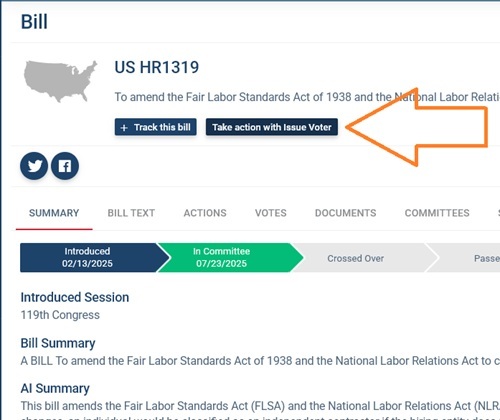
IssueVoter is a nonpartisan, nonprofit online platform dedicated to giving everyone a voice in our democracy. As part of their service, they summarize important bills passing through Congress and set out the opinions for and against the legislation, helping us to better understand the issues. BillTrack50 is delighted to partner with IssueVoter and we link to their analysis from relevant bills. Look for the IssueVoter link at the top of the page: