


*** Don't feel like reading? No worries! Watch us discuss this bill on Youtube or our Substack, or listen to the discussion on our Podcast: BillTrack50 Beyond the Bill Number on Apple Podcasts, Spotify, YouTube or where ever you get your podcasts ***
Virginia has decided to plunge feet first into a mid-decade redistricting arms race that is already underway around the country. The center of that fight is Virginia HJR4, the January 2026 joint resolution that cleared the House on January 14 and the Senate on January 16, setting up an April 21 statewide referendum on whether the General Assembly may temporarily redraw Virginia’s congressional map before 2031. The vote is going forward, but the legal fight is not over; the Supreme Court of Virginia has allowed the referendum to proceed and said the remaining legal questions can be sorted out after the election.
That makes Virginia one of the clearest examples of how a state-level procedural fight can suddenly become a national House-control story. Mid-decade redistricting was not born in 2025, but this round was plainly accelerated when Donald Trump urged Texas Republicans to redraw congressional lines for partisan advantage. Since then, the map war has spread fast: the National Conference of State Legislatures said on March 3 that six states had already implemented new congressional maps for 2026, while others, including Virginia, were still trying to join the club. AP’s rundown of the current cycle likewise described the fight as having been jump-started by Trump’s push in Texas, with California, Missouri, Utah, Ohio and other states swept into the same broader contest.
HJR4 matters because it is the legal hinge, not the map itself. Virginia voters approved a constitutional amendment in 2020 shifting congressional redistricting away from the legislature and to a bipartisan commission, with redistricting ordinarily happening once every ten years. HJR4 is the “second reference” measure needed under Virginia’s amendment process, and it would carve out a temporary exception: if another state redraws its congressional map outside the normal census cycle and not because a court ordered it, the General Assembly could redraw one or more Virginia congressional districts through October 31, 2030, after which the regular commission process would resume in 2031. In other words, the argument for HJR4 is not that Virginia’s old system was bad, but that Virginia needs an emergency escape hatch because other states have decided to play hardball.
The actual redraw lives in HB 29, which the General Assembly passed in February and Governor Abigail Spanberger signed on February 20. But that map only takes effect if voters approve the amendment. Under the current map, Virginia’s delegation stands at 6 Democrats and 5 Republicans. Under the proposed map, analysts using 2025 gubernatorial results as a baseline say Democrats would have the advantage in 10 of Virginia’s 11 districts. That is the political payload hidden inside the procedural wrapping paper.
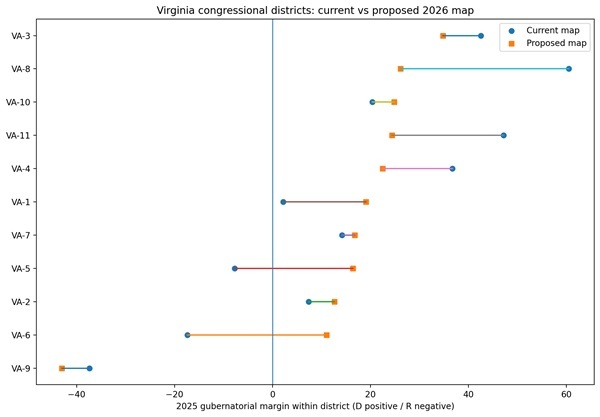
AI-generated district-by-district comparison of 2025 gubernatorial results under the current and proposed maps
And the change is not subtle. Ballotpedia’s district-by-district comparison shows that Districts 5 and 6, which currently lean Republican based on the 2025 governor’s race, would become Democratic-leaning under the proposed lines, while District 1 would move from a narrow D+2.2 environment to about D+19.1, and District 2 would become more comfortably Democratic as well. Four already Democratic districts would become less blue, but still remain Democratic on those same numbers, while District 9 becomes slightly more Republican. Put differently: the proposal does not merely tidy the furniture; it relocates the house.
Geographically, the map tells its own story. Cardinal News noted that the proposed 5th would stop being a Southside-plus-Charlottesville district and become overwhelmingly Richmond-based, while the 6th would stitch together the Roanoke Valley, Charlottesville, Lynchburg and parts of the Shenandoah region into a new Democratic-leaning coalition seat. The proposed 7th has already earned the nickname “the lobster district,” because although it sprawls through rural Virginia, most of its voting-age population would sit in Northern Virginia. The proposed 8th would stretch south to York County and pair two incumbents, Don Beyer and Rob Wittman, inside a district still designed to favor a Democrat. Those details matter because the debate is not only about seat counts; it is also about whether communities are being linked by shared interests or by shared partisan usefulness.
Supporters of HJR4 have settled on a simple case: reciprocity, urgency and voter permission. The official ballot language itself says the amendment would allow the General Assembly to “restore fairness” in the upcoming elections while preserving the ordinary process after the 2030 census. The Democratic Party of Virginia has framed the measure as a way to “protect Virginia’s voice” and stop Trump and MAGA from rigging the midterms, while the pro-amendment committee Virginians for Fair Elections says the measure is a temporary response meant to neutralize a Republican power grab and level the playing field. Their best argument is that Virginia voters still get the final say, because no map goes into effect without the referendum. Their second-best argument is that unilateral disarmament may be morally satisfying, but it does not win House majorities.
Opponents have an equally clear, and in Virginia perhaps more emotionally intuitive, answer: this is gerrymandering with a nice haircut. The Republican Party of Virginia’s message is blunt: Democrats are rewriting the rules in the middle of the game to entrench themselves in power, override the will of the voters who backed the independent commission in 2020, and try to convert a roughly evenly divided state into a 10-to-1 congressional delegation. Former Attorney General Jason Miyares has been making the same point on the stump, arguing that the map tells large parts of rural Virginia their voices do not matter. That message has real traction because it taps into something deeper than partisanship: many Virginians were told only a few years ago that the commission model was the cure for self-interested line-drawing, and now they are being asked to accept a temporary exception that just happens to arrive at the exact moment it benefits the party in power.
The messaging battle has therefore become a contest between two loaded words: fairness and gerrymandering. Supporters are leaning hard on democratic self-defense, anti-Trump language and the idea of a one-time emergency fix. Opponents are leaning just as hard on hypocrisy, rural disenfranchisement and the simple slogan “Stop Gerrymandering.” Even the ballot question has become part of the campaign, because the phrase “restore fairness” is a persuasive nudge for the yes side and a standing irritant for the no side, which has argued in court that the language is misleading. Meanwhile, money has poured in. WSET, citing VPAP data in March, reported that the pro-redistricting side had raised more than $27 million compared with just under $500,000 for the opposition. That is a huge edge, but it also reinforces the Republican claim that this is a nationalized proxy war, not a tidy local reform debate.
The polls suggest voters are movable, which is another way of saying both parties have reason to be nervous. Christopher Newport University found in January that 51% supported a temporary constitutional change allowing the legislature to redraw lines in response to other states, though 63% also said they preferred the current method overall. Then Roanoke College found in February that 62% supported the current method and that, in a referendum framed around the General Assembly’s proposed change, 52% would vote to keep the current process and 44% would adopt the amendment. Roanoke’s own analysis added an important caveat: the official “restore fairness” wording could still affect the final outcome. This is one of those ballot fights where the public seems to like the principle of reform and the principle of retaliation, just not always at the same time.
That uncertainty feeds into the biggest strategic risk for Democrats: turnout. Special elections are strange creatures, and strange creatures do not always obey the money. NBC reported in March that Democrats were starting to worry the referendum was not a done deal, despite their financial edge, and 29News reported that turnout had become the central concern for supporters. As of March 26, about 499,000 Virginians had already voted early, and other reporting on the early-vote data showed Republican-leaning areas turning out more heavily than Democratic ones at that stage. If the yes campaign’s theory is that democratic norms can be bent in order to save democratic norms, it needs high-engagement Democratic-leaning voters to buy that logic in an off-cycle statewide vote. That is a harder sell than it looks in a donor memo.
There is also a legal risk that never quite leaves the room. The Supreme Court of Virginia has now twice allowed the referendum to proceed, but it has also made clear that the underlying legal questions remain live and will be addressed after the vote if the amendment passes. Among the unresolved issues are whether the legislature lawfully got the amendment onto the ballot and whether the ballot language itself is improperly slanted. So even if the yes side wins on April 21, it may not immediately get the clean triumph it wants. And if the no side wins, the whole edifice collapses into mootness and the current map remains in place. That is a lot of uncertainty to build into an argument that is, at bottom, asking voters to endorse certainty.
So what is Virginia really voting on? Officially, it is voting on whether to let the General Assembly temporarily redraw congressional districts because other states have already done so, with the commission resuming control after the 2030 census. Politically, it is voting on whether a state that once sold itself on redistricting reform should suspend that reform in order to answer a national partisan escalation started elsewhere. A yes vote would activate HB 29 and put the new map in place for the 2026, 2028 and 2030 elections before the regular commission returns in 2031. A no vote would leave Virginia’s current process and map in place until the normal post-census redraw. The cleanest way to put it is this: Republicans started the latest map war, but Virginia Democrats are asking voters for permission to fight it their way. On April 21, Virginians will decide whether that is a defense of fairness or just a better-worded gerrymander.
About BillTrack50 – BillTrack50 offers free tools for citizens to easily research legislators and bills across all 50 states and Congress. BillTrack50 also offers professional tools to help organizations with ongoing legislative and regulatory tracking, as well as easy ways to share information both internally and with the public.